

Architectural historian YEO KANG SHUA critiques the unease written into Singapore’s fabric, and argues that conservation is a discipline of attention we can all practise. This essay is adapted from his remarks at the “States of Unease” Public Forum. [1]
Buildings talk. I have learned to listen.
I give my students one instruction before any other: do not look at architecture. See it. We pass through our city every day and we look at it constantly, but we rarely see it. We rarely see what time, use, care, neglect and memory have left behind. My work is to teach that kind of seeing.
Take any old wall in this city. The lime plaster tells you what was available and affordable when it was built. A change in the brick coursing halfway up may tell you that the work stopped and started again, perhaps because money ran out or someone changed their mind. A patch of newer render marks where something was removed and never replaced. Layers of paint record each occupant’s idea of respectability and aesthetic taste. None of this is written down anywhere. The wall is the only document.
I am trained as an architect and I work as an architectural historian, and what I do is conservation. In practice that means burrowing in darkened archive rooms, consulting old books in libraries, directing conservation work on building sites, and, more recently, analysing old materials in laboratories. It sounds eclectic, but it is one pursuit: trying to understand what we have inherited, before we decide what to change.
I want to suggest that the unease this forum is asking about is not only social. It is written into the fabric of our city. You can read it in our walls.
When I say “we”, I do not mean the planners or the authorities. I mean all of us, the society we make together. And we manage our unease much as we solve most things, by making them efficient, clean, renewed and future-ready. That is our shared narrative, and it is a genuine achievement. We are admired for it, and rightly. The world comes to study our planning: the garden city, the greenery threaded through a dense island, the HDB estates that house the overwhelming majority of us. That achievement is real, and I have benefited from it like everyone else. But there is a gap between the story and the practice, and it belongs to all of us. We tell ourselves we are a society that honours its heritage. In practice we honour a curated, photogenic version of it, the gazetted monument and the restored shophouse, and we let much of the rest go. And when it goes, we do not only lose buildings.
We lose, or stand to lose, the communities and attachments that lived in them: the old Marine Parade Community Building, much of Dakota Crescent, and Yishun 10, the cinema some of us grew up with.[2] The neighbourhood quietly disappears between one visit and the next.
And often it goes early. The Singapore Heritage Society put it well: its 2018 position paper and exhibition on our modernist icons was called Too Young to Die.[3] These were buildings threatened with clearance before we had properly decided whether they mattered, while still in their first working life. The phrase names the particular unfairness of it. Not that these buildings grew old, but that they were never allowed to.
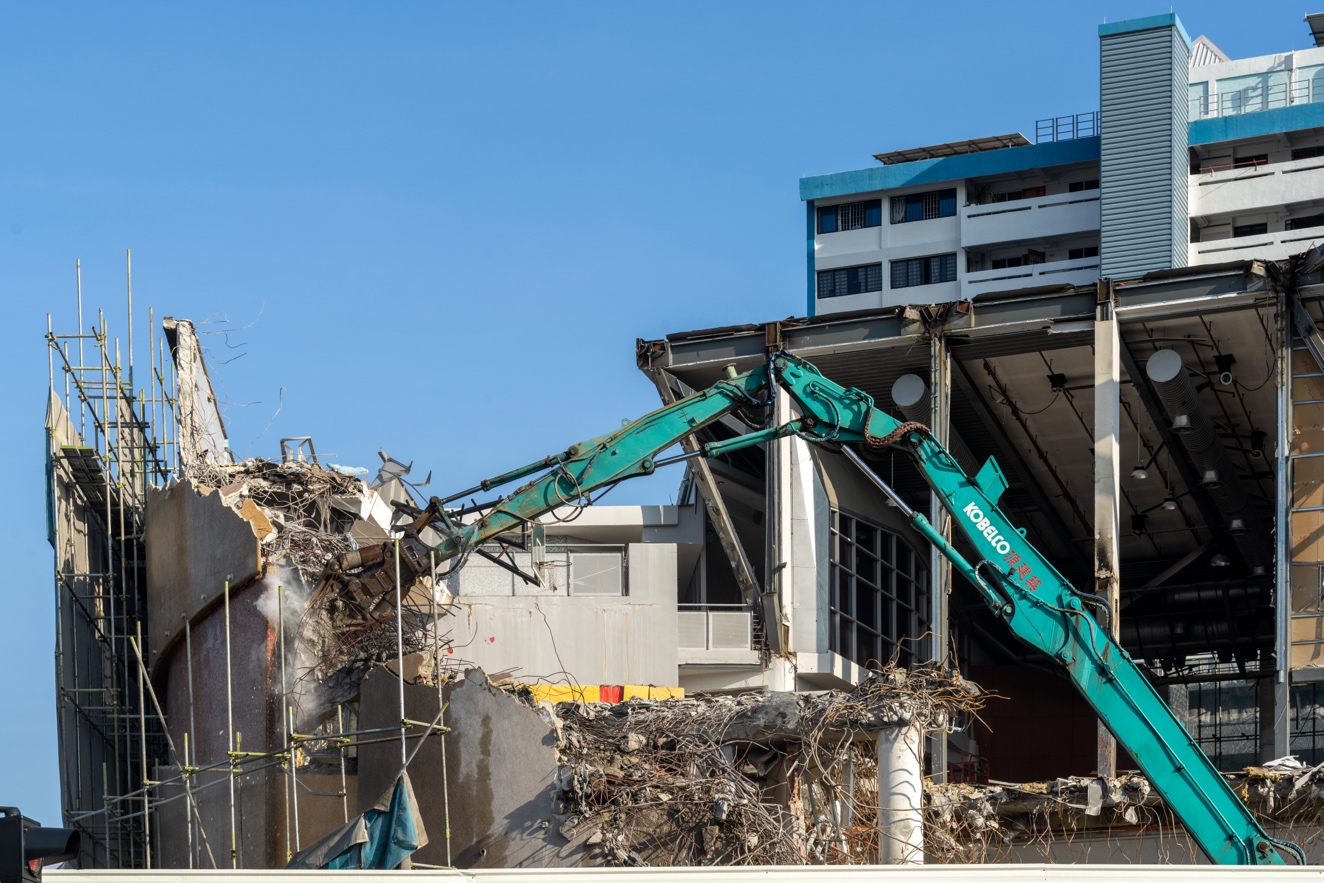
Photograph showing the demolition of Marine Parade Community Building. (Photograph courtesy of Darren Soh)
The photograph I showed that evening was one of Darren Soh’s: the old Marine Parade Community Building in the middle of being torn down. It belongs among many of his photographs in a category defined by his book Before It All Goes,[4] his record of buildings in their last months, a project to which I contributed an essay on our vanishing swimming pools. I have come to think that a photograph is not a substitute for a building. It is what we are left with once we have decided not to keep one.
A system that sorts, ranks and smooths
So the contradiction I would name is this. We are rhetorically pro-heritage in much the way we are rhetorically pro-family. We say these things matter deeply. But the habits we actually live by work against ever keeping anything for long: our appetite for land value, our love of efficiency, our sense that newer is a duty. And conservation cuts both ways. The same instinct that authors the smooth national story also authors the official heritage. Heritage, too, can be managed, branded, made smooth.
Underneath the achievement, then, is a single reflex, and it runs through much more than architecture. It is a system that sorts, ranks and smooths. It sorts places into those worth keeping and the vast residue of “little architectural merit.” It ranks them in a descending order of worth: the gazetted monument above the conserved shophouse, the shophouse above the void deck, the void deck above nothing at all. And then it smooths: repairs the surface, tidies the irregularity, makes the awkward presentable, until what is left is a version of the past with the friction taken out. The sorting is not a flaw in the pursuit of efficiency. It is part of how efficiency is achieved. And it is ours, a collective habit of mind, not a policy handed down to us.
If you want the sharpest illustration of what the smoothing does, look at facadism, the practice of keeping a building’s face while gutting everything behind it. We conserve the appearance and discard the thing that made it mean anything. A gentler version of the same instinct keeps a fragment. At the former Police Academy at Mount Pleasant, where thousands of new flats are now rising, the redevelopment plans retain six starter blocks from the old swimming pool and reuse them as seating in the new estate.[5] I do not want to be ungenerous about this. Keeping and reusing a real artefact is more thoughtful than sweeping it all away, and much of our early swimming-pool heritage has already gone without even that much. But a starter block set into a courtyard will also resemble a headstone. It marks, with some tenderness, the grave of the pool it once belonged to, and invites us to read the fragment as though the whole were still here. We keep the token and lose the thing.
The assumptions we hold sacred
This is not abstract, and it is not history. Much of the current change is being carried forward under Master Plan 2025, Singapore’s statutory land-use plan for the next ten to fifteen years. The Government has also announced plans for at least 80,000 new homes across more than ten new housing areas during this period. One of the Master Plan’s themes is “Stewarding Nature and Heritage.”[6] I want to be fair to this theme. It retains named buildings, traces green “identity corridors,” and keeps habitat at the edges; it is a real attempt to hold heritage and nature in the frame while the island houses its people, and it is more than earlier plans offered. As I write, two sites, Gillman Barracks and Maju Forest, are open for public feedback until the sixth of August, each with environmental and heritage studies published for anyone to read. At Gillman, a heritage study assessed 86 buildings and structures. The agencies propose retaining 25 of them, including all four rated “Exceptional” and 21 of the 27 rated “High”.[7] At Sunset Way (Maju Forest), the studies record habitat used by species including the straw-headed bulbul, a songbird listed globally as Critically Endangered, for which Singapore remains a vital stronghold.[8] The question worth asking is not whether the intention behind all this is sincere. It is whether we have examined the assumptions underneath it.
Every plan like this rests on an assumption we are taught early and rarely question. We are told that Singapore is small, an island state whose finite land must do an enormous amount of work at once: it has to house us, to catch and hold our water, to carry our industry, to make room for the airport and the port, and to give the military ground to train on. That is true, and it is not trivial. Land here is genuinely limited. But land is not the same as space. We can, in some places, build higher and denser, although engineering, infrastructure, environmental and liveability constraints remain. The harder question is whether we are willing to concentrate greater density in some parts of the island so that others can be left undeveloped. That is a real choice, with real trade-offs, and it belongs to us. We should not treat “we have little land” as the end of the conversation, when what we often mean is that we have not decided what we are willing to trade.
One of my fellow panellists made a sharper point about that word. “Trade-offs,” he observed, has become a phrase we reach for to close a conversation rather than open one: name a trade-off, and the discussion is meant to stop, because who can argue with necessity? But a trade-off means something only if we can see both sides of it. What exactly are we trading, and for what? Who carries the cost, and who takes the gain? Those are the questions the word should invite, not foreclose. If land is genuinely scarce, then the scarcity, and the choices it forces on us, are precisely what we should be debating in the open. Naming a trade-off ought to be the beginning of the discussion, not the end of it.
And we are not without an instrument for having that conversation properly. The tool is the impact assessment. An Environmental Impact Assessment, and its heritage counterpart the Heritage Impact Assessment, are built to do precisely what the word “trade-off” pretends to have settled: they identify what a project may cost in nature or heritage, examine alternatives, and propose concrete measures to avoid or mitigate the loss, all before the decision is fixed and while there is still room to change it. They do not settle the trade-off, but allow it to be decided with fuller information. The Gillman and Maju studies are of this kind, and they exist because the state has, to its credit, been building this machinery out. In March 2022 the Government introduced a Heritage Impact Assessment framework, under which public projects “likely to cause a major impact on significant heritage sites” are assessed for whether an in-depth, independent HIA is needed.[9] That is real progress, and I welcome it.
But notice how much rests on two expressions that are not defined in the publicly available statement: “major impact” and “significant heritage sites”. The published material also does not explain the criteria used to decide whether an in-depth assessment is required. The framework is triggered only when a project is “major” and a site “significant.” It decides whether an assessment is needed; it does not guarantee one. Its whole reach depends on how those two words are read, and they are read out of public view. That is precisely the judgement we should be arguing over in the open. Trent Ng, whose policy research on this I had the good fortune to mentor, made the case, before the framework existed, for a mandatory and publicly accessible heritage-assessment regime tailored to Singapore.[10] The 2022 framework is a step along that road. I would ask that we finish the walk: say what counts as major, widen the coverage beyond public projects, and make the assessment mandatory rather than discretionary, so that whether the trade-offs get examined at all turns on rule rather than on goodwill. To the state’s credit, the studies themselves are already published for comment, as the Gillman and Maju consultations show; what stays out of public view is the step before that, the decision on whether an in-depth assessment is required at all, and on what threshold.
Other assumptions deserve the same scrutiny. When we do need to take land, do we exhaust our brownfield and already-vacated sites before we open a forest? How are cost, timing, infrastructure requirements and ecological value weighed against one another? I have little doubt that planners weigh these questions internally. My argument is not that the questions go unasked, but that the reasoning behind the choices is not always made visible, or opened to public discussion while there is still room to shape the alternatives. A blanket “build” or a blanket “keep” answers none of them, and because the answers turn on trade-offs that each of us would weigh differently, they are the kind of judgement the public should be brought into, not simply shown the conclusion of. To pretend the questions are simple is one form of avoidance; to settle them out of public view is another.
But the assumption I would most like to unsettle is one that still shapes much public debate: that a building must either be conserved whole or demolished whole. Conservation practice has long recognised a wider range of interventions, but this middle ground remains underused. In practice heritage almost never works so neatly.[11] Between the two extremes lies a wide middle ground we barely use. We can adapt and reuse the building stock we already have instead of clearing it, keeping its embodied carbon and its memory in service rather than starting again. We can redevelop in part, keeping what carries meaning and rebuilding the rest. We can raise the density of a site while keeping its most loved structure alive inside the new one. Facadism, keeping only the mask, is the impoverished version of this idea. The richer version keeps the building working, not merely its face.
I should be honest about my own place in this. I am part of the apparatus I am describing. The conservation I practise is itself one of the ways architecture gets cleaned up, as much as I try to keep the patina. Surfaces repaired, irregularities smoothed, the awkward made presentable. Guilty as charged. So when I argue for friction, I am arguing against a reflex in my own profession, and in myself. This is not a finger pointed outward. It is a mirror I am holding up first to my own trade, and then to all of us.

The States of Unease forum featured eight speakers from academia, the arts, and the activist community.
What a good life needs
What does the smoothing cost us? I have come to think the honest answer is a whole conception of the good life, and that conservation, properly understood, is one of the few disciplines that can name it.
We are used to measuring a good life in what can be added: a better flat, a lift, a shorter commute, a newer facade. Those goods are real, and I do not dismiss them. But there is a second set of goods that cannot be built, only kept, and that the sorting-and-smoothing reflex quietly erases. A good life needs continuity, the sense that the place you belong to will still be there to be belonged to. It needs age, not as decline but as accumulation, the visible proof that time has passed and been survived. It needs repair over replacement, because a thing mended carries its history where a thing renewed erases it. It needs attachment, ritual and craft, and the unresolved traces of the people who came before us. Above all it needs the ability to keep what you love long enough for it to become part of who you are.
These are not luxuries, and they are not nostalgia. They are the texture of a life that feels like a life. A city that keeps only what is new risks telling its people that there was only one way to have lived here, and that whatever they were attached to did not count. The people most harmed by a city that will not hold still are usually not the mobile and the well-resourced, who can move with it, but those with the least capacity to move at all.
Let me make this concrete, because I put the same case to the forum. Suppose you live in an HDB flat that happens to carry real architectural or historical value. You also live with its age: the spalling concrete, the sewerage pipes that leak, the small daily indignities of a block that has done its work for decades. Then the announcement comes that your block will be taken back and redeveloped. Are you happy, or are you sad? I think the only honest answer is both. The new flat is a genuine gain, and the relief from the leaks is real; I would feel it too. And at the same time something is being lost that will not come back, a particular place that held a particular life. To be allowed only the first feeling is to be told that half of your own experience does not count. It is human to be both at once.
Borrowing a term from bereavement studies, we might describe some of this as “disenfranchised grief”: a loss that is real but not publicly recognised, so there is no ritual for it and little permission to mourn.[12] When your childhood estate goes, nobody sends condolences. There is no funeral for a building; you are simply expected to be pleased. You can be glad of the new flat and sorry for the old one at the same time. That is ordinary adult experience, and yet our public language has almost no room for the second feeling. That silence is not only a private sadness. When we cannot voice mixed feelings, the decision hears no signal that anything was lost, and so the loss never enters the reckoning. A good life, and a good society, should be confident enough to hold both feelings at once.
Nor is it only buildings that go. When two schools are merged, or one is closed, the site may be reused but the name is retired, and with the name a whole seam of people’s growing-up years. Between 2019 and 2025, the Ministry of Education merged eight junior colleges into four, as well as several primary and secondary schools, largely in response to falling enrolment. Some students and alumni expressed sadness at the loss of familiar names and identities. Schools, unlike most buildings, are sometimes granted a farewell, a decommissioning ceremony, a flag lowered a last time. It is a rare public ritual for this kind of loss, and it is telling that we extend it to a school and almost never to a home. But a ceremony does not undo the erasure. What is written over is not a structure but an identity, the word thousands of people once used to say where they were from.[13]

Before Anderson Junior College students had to move out of their Ang Mo Kio campus to merge with Serangoon Junior College, they launched Project Graffiti: each class adopted a wall in their old building to make their own before its demolition. (Photo: ASRJC)
Two old but good questions
This is why I want us to refuse the frame in which these arguments usually arrive: old versus new, preservation versus progress. It is a frame that heritage always loses, and should, because progress is popular and nostalgia is not. There are two better questions, and they belong to everyone, not to experts. Whose attachments count? And who decides? Nobody calls it nostalgia when a shophouse district is kept for tourists; they call it nostalgia when a hawker centre or a void deck is kept for the people who live there. Too often, the word tracks the class of the person doing the remembering.[14]
I should be honest that I am not against choosing. On a finite island we must choose, and to choose is to rank. My quarrel is not with ranking itself but with the yardstick we use and with who is allowed to hold it. Measure a place by association, by who gathered there and what it held, rather than by land value or photogenic merit, and a different set of buildings survives. The problem is not that we rank. It is that we rank narrowly, and in private.
The difficulty beneath both questions is not standing in the strict legal sense, but decision-making power. Heritage protection here is closely entangled with property. Planning and conservation powers lie principally with public authorities, while owners and developers hold proprietary interests in the land and buildings concerned. Tenants, users, worshippers and passers-by may have deep attachments and may submit representations, but they seldom possess an equivalent power to determine what happens to a place. Those who have made much of the city meaningful may have a voice, but rarely a decisive one. This has particular force in Singapore. Roughly nine-tenths of Singapore’s land is state-owned, much of it assembled over decades through compulsory acquisition, and close to four in five residents live in HDB flats, generally sold on ninety-nine-year leases rather than freehold title.[15]
Planning and conservation powers attach to whoever holds the title, so the decisive voice belongs to the state or to the developer, and seldom to the people who live, work or worship in a place. Tenants, users, worshippers and passers-by have memories but no standing. Those who have built much of this city and own none of it have no standing to keep any of it. This is a defect in my discipline, and I would rather name it plainly than smooth it over. What I would ask us to change is the burden of proof. At present the question we put is why a building should be kept. We almost never ask why it should go.
A call to look, and to write
None of this is an argument for stopping. Friction is not freezing. On a land-scarce island with real housing demand, these are genuine costs, not free wins, and I am not asking the city to stand still. I am asking us to know what we are spending.
And here the argument turns from diagnosis to something each of us can do, because the conversation has already broadened beyond my profession, whatever my profession sometimes thinks about it. The strongest heritage arguments of recent years have come not from experts but from residents, users and people in their twenties and thirties, often over ordinary buildings from the 1970s and 1980s rather than the colonial fabric earlier generations of conservationists fought for.
I should not pretend that the people most readily heard in these debates are a cross-section of the city. In my experience, heritage advocates, myself among them, tend to be educated and securely housed, with the time, language and confidence to navigate formal channels. That is not a rebuttal of my point but a sharpening of it. If even the articulate must strain to be listened to, the renters, migrant workers and those who use such places informally face far greater barriers to being heard. Widening who counts, and lowering the bar to being heard, is not a footnote to the argument. It is the argument.[16]
It helps to know that, in certain planning processes, public participation is not merely a favour we are granted but part of the statutory procedure. When a material amendment to the Master Plan is proposed through the statutory process, it must be publicised and made available for inspection. Written objections and representations may then be submitted within the stated period. Unless considered frivolous, they carry an opportunity to be heard before the proposal is approved.[17] It is an established, statutory channel, not a suggestion box. Most of us walk past the Master Plan exhibition without knowing it is one formal moment the law sets aside for our objections and representations to enter the planning process. Ironically, the visitors who study it most closely are often property agents and investors, reading it for land value rather than for what stands to be lost.
Which is why it matters to be clear that submitting feedback is not the same as signing a petition. A petition is an expression of feeling; it shows that many people care, and that has its place. But a representation through the statutory channel is a specific, reasoned submission that the process must weigh. The two are often confused, and the confusion is costly. When Dover Forest was contested in 2021, tens of thousands signed a petition, while roughly 1,800 responses were submitted through HDB’s formal feedback channels. HDB subsequently revised the plan, retaining the biodiversity-rich western portion for the time being.[18]
This does not prove that the formal submissions alone determined the outcome, but it shows that they entered the documented decision-making process. A petition and a formal representation do different work. A petition demonstrates the breadth of public concern; a reasoned representation enters the planning record. Both may matter, but they should not be confused. So when such consultations are open, the most useful civic act is often a dull one. Write through the proper channel before the deadline, and propose specific alternatives rather than only objecting. And in whatever register is yours: document. Photograph, record the oral histories, name what is there before it is gone. Seeing is free, and it is teachable, and it is the beginning of standing.
That, in the end, is what conservation offers beyond old buildings. It is not nostalgia. It is a discipline of attention, the practice of seeing what we have inherited, and asking who it belonged to, what it held, and what we would lose, before we decide what must change. It is a discipline anyone can practise, and I would like us to practise it together.
I began with a wall, so let me end on one. Learn to read it, and you will never again believe this island has no memory. That reading is something any of us can do. Seeing clearly is not the opposite of progress. It is the precondition for deciding, together, what kind of progress is worth having.
– YEO KANG SHUA works mainly in architectural conservation, across archives, laboratories, and conservation sites. He studies buildings not only as physical fabric, but also as carriers of craft, memory, and cultural life. His work includes religious and institutional buildings in Singapore, some recognised by the UNESCO Asia-Pacific Awards.
The entire forum can be viewed on YouTube. For other speakers’ articles, visit the event site.
Notes
[1] The views expressed are the author’s own
[2] On these three losses: the old Marine Parade Community Building, whose postmodern facade incorporated the mural Texturefulness of Life, was demolished in 2023 and replaced by a new community building (its modernist significance and demolition are documented by Docomomo Singapore, of which Darren Soh is a founding member). Dakota Crescent, a Singapore Improvement Trust estate of 1958, was vacated by its remaining households (about 400) by the end of 2016; the dove playground and six surrounding blocks were retained following the Government’s December 2017 decision. Yishun 10 (GV Yishun), Singapore’s first multiplex cinema when it opened in 1992, was proposed for redevelopment into housing after URA published a change-of-use amendment for the site on 8 May 2026, rezoning it from commercial to residential with commercial on the first storey; see “Yishun 10, S’pore’s first multiplex, set to make way for residential and commercial building,” The Straits Times, 9 May 2026. https://www.docomomo.sg/modernist-100/marine-parade-community-building; https://lkyspp.nus.edu.sg/docs/default-source/case-studies/ground-up-heritage-in-singapore—dakota-crescent.pdf accessed 23 July 2026.
[3] Singapore Heritage Society, Too Young to Die: Giving New Lease of Life to Singapore’s Modernist Icons (Singapore: Singapore Heritage Society, August 2018), position paper accompanying the exhibition at The Substation.
[4] Darren Soh, Before It All Goes: Architecture from Singapore’s Early Independence Years (Singapore: Objectifs, 2018). https://www.objectifs.com.sg/before-it-all-goes/ accessed 23 July 2026.
[5] Housing & Development Board, “HDB Unveils Masterplan for Mount Pleasant,” press release, September 2025, on the proposed retention and reuse of six starter blocks from the former Police Academy swimming pool as seating at Mount Pleasant Crest. https://www.hdb.gov.sg/about-us/news-and-publications/press-releases/hdb-unveils-masterplan-for-mount-pleasant accessed 23 July 2026.
[6] Urban Redevelopment Authority, “Gazette of Master Plan 2025,” 1 December 2025, and “Stewarding Nature and Heritage,” Master Plan 2025. Master Plan 2025 was officially gazetted on 1 December 2025 and guides Singapore’s physical development over the next ten to fifteen years; “Stewarding Nature and Heritage” is one of its four themes. See also Ministry of National Development, “Speech by Second Minister Indranee Rajah at the Committee of Supply Debate,” 4 March 2026, on the Government’s plans for at least 80,000 new homes across more than ten new housing areas over the next ten to fifteen years. Also see Master Plan 2025’s theme “Stewarding Nature and Heritage”: https://www.ura.gov.sg/news/media/pr25-32/; https://www.uradraftmasterplan.gov.sg/themes/stewarding-nature-and-heritage accessed 23 July 2026.
[7] Housing & Development Board, Gillman Barracks: Heritage Impact Assessment Report and Environmental Impact Assessment: Main Report, 10 July 2026. The HIA assessed 86 buildings and structures. The planning proposal provides for the retention of 25, comprising all four rated “Exceptional” and 21 of the 27 rated “High”. The reports were published for public feedback until 6 August 2026. https://www.hdb.gov.sg/-/media/about-us/our-role/plan-and-design-towns/planning-with-the-environment-in-mind/Gillman-Barracks-HIA_Report.pdf; https://www.hdb.gov.sg/-/media/about-us/our-role/plan-and-design-towns/planning-with-the-environment-in-mind/Gillman-Barracks-EIA_Main-Report_Final.pdf accessed 23 July 2026.
[8] On the Sunset Way plan, see Housing & Development Board, Environmental Impact Assessment for Proposed Residential Development at Sunset Way: Final Report, July 2026, published for public feedback until 6 August 2026. On the straw-headed bulbul (Pycnonotus zeylanicus), listed globally as Critically Endangered, see the IUCN Red List of Threatened Species and National Parks Board, National Species Action Plan for the Straw-headed Bulbul, October 2025. NParks describes Singapore as a “vital stronghold” for the species. https://www.iucnredlist.org/; https://www.nparks.gov.sg/docs/default-source/resources/2024/national-species-action-plan-straw-headed-bulbul.pdf accessed 23 July 2026.
[9] Ministry of Culture, Community and Youth, “Safeguarding Singapore’s Tangible Heritage,” response to a parliamentary question, 8 November 2022. The response states that the Heritage Impact Assessment framework, introduced in March 2022, applies to “public projects likely to cause a major impact on significant heritage sites” and provides for an assessment of whether an in-depth and independent HIA is required. The published statement does not define “major impact” or “significant heritage sites”, or set out the screening criteria used to determine whether an in-depth assessment is necessary. https://www.mccy.gov.sg/about-us/news-and-resources/safeguarding-singapore-s-tangible-heritage/ accessed 23 July 2026.
[10] Trent Ng, Striking the Balance between Heritage Conservation and Urban Renewal in Singapore: Advocating for a Mandatory Heritage Impact Assessment (HIA) Regime, Policy Analysis Exercise final report, Master in Public Policy, Lee Kuan Yew School of Public Policy, National University of Singapore, 27 November 2015, prepared for the Singapore Heritage Society. The report recommends a comprehensive mandatory HIA regime tailored to Singapore, covering public and private projects, with public consultation and the publication of HIA findings, mitigation recommendations and final reports online. https://lkyspp.nus.edu.sg/docs/default-source/admissions/mpp/pae-final-report_trent-ng.pdf accessed 23 July 2026.
[11] Yeo Kang Shua, “Commentary: To conserve or demolish? Singapore needs a heritage middle ground,” CNA, 15 June 2026. https://www.channelnewsasia.com/commentary/yishun10-redevelopment-singapore-buildings-conservation-heritage-6178881 accessed 23 July 2026.
[12] Kenneth J. Doka, ed., Disenfranchised Grief: Recognizing Hidden Sorrow (Lexington, MA: Lexington Books, 1989).
[13] On the merger of eight junior colleges into four in 2019, and the mergers of primary and secondary schools between 2022 and 2025, see Ministry of Education, “Names of Primary and Secondary Schools Merging Between 2022 and 2025,” 6 April 2022. On the consideration given to school names, heritage and stakeholder sentiment, see Ministry of Education, “Heritage and Identity in Merged Schools,” parliamentary reply, 7 February 2024. For the responses of several women alumni of the affected junior colleges, see “This Is What Women Alumni of Affected JCs Have to Say about the Merger,” Her World. https://www.moe.gov.sg/news/press-releases/20220406-names-of-primary-and-secondary-schools-merging-between-2022-and-2025; https://www.moe.gov.sg/news/parliamentary-replies/20240207-heritage-and-identity-in-merged-schools; https://www.herworld.com/life/singapore-junior-college-merger-closure-jurong-yishun-tampines-pioneer-anderson-serangoon/ accessed 23 July 2026.
[14] On the tendency of official heritage practice to privilege expert, monumental, aesthetic and material values over everyday and community attachments, see Laurajane Smith, Uses of Heritage (London: Routledge, 2006), especially chapter 1. On social value as arising from contemporary communities’ identity, belonging, memory and attachment to place, and the limitations of conventional expert-led assessments in recognising it, see Siân Jones, “Wrestling with the Social Value of Heritage: Problems, Dilemmas and Opportunities,” Journal of Community Archaeology & Heritage 4, no. 1 (2017): 21–37.
[15] State ownership of land in Singapore rose from roughly 44 per cent in 1960 to about 90 per cent, substantially through compulsory acquisition following the Land Acquisition Act 1966; see Anne Haila, Urban Land Rent: Singapore as a Property State (Chichester: Wiley Blackwell, 2016). On the statutory land-acquisition process, see Singapore Land Authority, “Acquisition of Land.” On public housing, HDB reports that its flats house close to 80 per cent of Singapore’s resident population; see Housing & Development Board, “About Us” and HDB Key Statistics FY2024/2025. https://www.sla.gov.sg/properties/acquisition-of-land/; https://www.hdb.gov.sg/-/media/doc/SCEG/HDB_Key-Statistics-2025.pdf accessed 23 July 2026.
[16] This is an observation drawn from the author’s experience of heritage advocacy rather than a claim that advocates form a uniform social group. The point is that formal consultation processes tend to favour those with the time, language, confidence and institutional knowledge needed to navigate them.
[17] Planning Act 1998, ss 8 and 10, read with the Planning (Master Plan) Rules, rr 4–6. The Rules provide for public notice and inspection of a proposed material amendment, a period of at least two weeks for written objections and representations, and, except where a submission is considered frivolous, an opportunity for the person submitting it to be heard or for a public inquiry to be held. An amendment that the Minister considers not material in nature may be approved without public notice. https://sso.agc.gov.sg/Act/PA1998; https://sso.agc.gov.sg/SL/PA1998-R1 accessed 23 July 2026.
[18] On Dover Forest, see Housing & Development Board, “Summary of Response to Feedback on Environmental Baseline Study for the Ulu Pandan Site,” July 2021. HDB received around 1,800 responses through its feedback channels and stated that, taking into account the environmental studies and public feedback, it refined its plans: the western portion would be left undeveloped in the medium term and reviewed again in about ten years, while a sizeable nature park would be safeguarded. On the online petition, see Ng Keng Gene, “Keeping Half of Dover Forest as Nature Park a Win for All: Nature Groups, Residents,” The Straits Times, 30 July 2021, which reported more than 50,600 signatures. These sources establish the sequence of consultation and revision, but not that either the petition or the formal submissions alone determined the outcome.